Book review Sri Krishna Prem: A Wing and a Prayer
One thing that continues to fascinate me is people that have been influential in their own time but have dropped off the radar since and received comparatively little attention since. When a friend alerted me to Jon Chapple’s biography of Sri Krishna Prem, I knew this would be a fascinating read. An Englishman, born Ronald Henry Nixon, who served in the Royal Flying Corps in the First World War. After the war, he became Professor of English at Lucknow and Banares Universities; and in his final incarnation, as it were, became Sri Krishna Prem – a Vaiṣṇava spiritual leader who attracted both Indian and western followers, including counter-cultural figures such as Timothy Leary and Ram Dass.
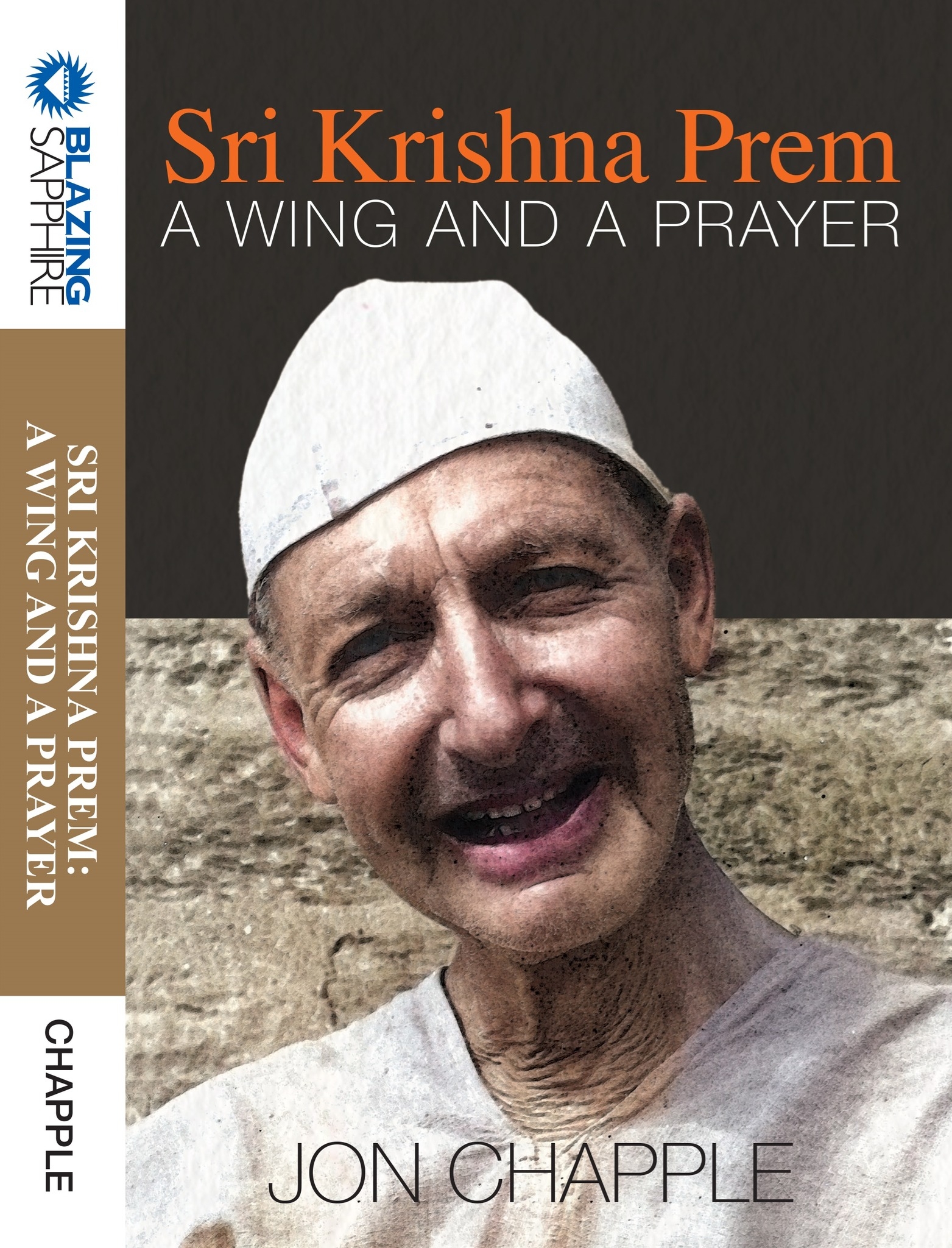
Jon Chapple’s Sri Krishna Prem: A Wing and a Prayer (Blazing Sapphire Press, 2024) is an impressive and thoroughly researched biography of Sri Krishna Prem/R.H. Nixon.
The first part of the book deals with Nixon’s early life and military service. Nixon, like many of his contemporaries, was introduced to Indian thought, in particular, the works of Adi Sankara, and Buddhism – through the Theosophical Society. Indeed, it was through his Theosophical contacts, notably Bertram Keightley, that he secured a position of associate professor at Canning College in Lucknow. It was during this period that Nixon was to meet his spiritual teacher – Monica Chakravati, a devotee of Krishna – later known as Yasoda Ma. She had initially taken a sakta initiation, but was soon after, granted, by the grace of the goddess, a Vaiṣṇava mantra.
Part two of the book focuses on Nixon’s transformation into Sri Krishna Prem and his life as a devotee of Kṛṣṇa, taking the name “Gopal”. He and Yasoda Ma began the search for a suitable site on which to build a temple, and finally settled on Mirtola, an isolated hill house. Here, Gopal took initiation as a vairāgi – a Vaiṣṇava renunciate. Gopal later took initiation into the Gauḍīya sampradaya. Whilst not the first westerner to become a devotee of Krishna, Krishna Prem is notable for attracting many Indian followers. Life at the temple/ashram followed strict orthodox ritual and behaviour. Krishna Prem also wrote several books, including The Yoga of the Bhagavat Gita – which influenced later spiritual seekers such as Ram Dass (Richard Alpert) and Krishna Das (Jeffrey Kagel). He stressed that the realization of God and the soul can only be brought about by a qualified teacher, and that “All attempts to practice yoga without a guru, and a real guru at that, end in either disappointed failure, trivial psychism, ill-health or madness.”
Although scrupulously adopting the practice and behavioural routines of a Vaiṣṇava renunciate, Krishna Prem retained the influence of his Theosophical background in his writings. His book The Yoga of the Bhagavat Gita for example, takes the events of the Gita to be allegorical, rather than literal history (the traditional view). He expounds in his various works the universalist position of Theosophy – that all traditions contain a common ‘great Truth’. He also rejected the fundamental Gauḍīya position that Krishna is the ultimate form of the divine, preferring instead an impersonal Parabrahman.
A Wing and a Prayer gives a unique perspective on the trials and tribulations of life at a Vaiṣṇava ashram. A great read for anyone interested in the early counter-culture, Theosophy, or Vaiṣṇava practice.
