On Bagalamukhi
A few notes on the goddess Bagalāmukhī, expanded from an entry in the London Tantra Discussion Group wiki.
“I meditate on Bagalamukhi, who with her hammer has killed my adversary, his unsteady rolling tongue having been pegged; the all pervading paralyser of speech and mind; who is seated on the corpses and skulls of one’s fallen enemies,(their remains forming the base) for her lion throne in the pavilion in the centre of a beautiful blossoming red lotus in the midst of the nectar-milk ocean.”
Hymn to Bagalāmukhī, translated by Mike Magee.
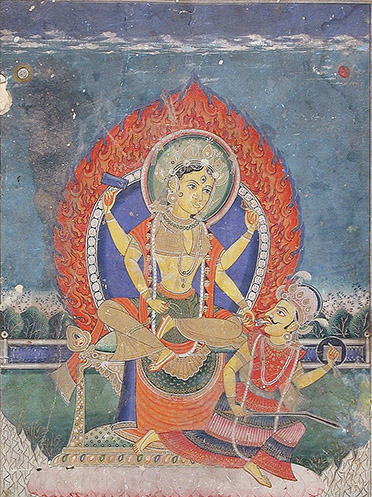
Bagalāmukhī is one of the group of goddesses known as the Mahāvidyās. She is usually placed as the eighth of the group (NB: the number of the Mahāvidyās is often given as ten, but sources differ. The Mālinīvijayottaratantra gives a list of twelve goddesses, whilst some Jain sources enumerate sixteen or seventeen goddesses). The name Bagalāmukhī can be translated as the “crane-headed one”. According to Mike Magee, the crane is thought to be “the essence of deceit.” David Kinsley finds this association problematic – he notes that Bagalāmukhī is rarely depicted as being crane-headed or crane-faced, although she is sometimes shown seated upon a crane.1
She has a strong connection to the acquisition of magical powers – in particular, the ability to control and paralyse one’s enemies and specifically, to bind the speech of enemies, although this may equally apply to the sadhaka’s uncontrolled speech (possibly the internal dialogue) as it might to the gossip of others. She may grant the siddhi of eloquence to favoured devotees. Her particular colour is yellow, which is often associated with stambhana rites of paralysis and the immobilisation of enemies (see, for example, Uḍḍiśatantra, 1.34). She is compassionate to the true devotee, and cruel to the devotee’s enemies. She is visualized as clothed in yellow and wearing yellow ornaments. Her devotees, several texts attest, should wear yellow and worship her with yellow flowers, foods, and a rosary of turmeric beads.
The Toḍalatantra says of her:
“Bagalāmukhī. Three eyes, wearing yellow clothes and gems, moon as her diadem, wearing champaka blossoms, with one hand holding the tongue of an enemy and with the left hand spiking him, thus should you meditate on the paralyser of the three worlds.”2
There are several versions of the origin of Bagalāmukhī. One of the most popular concerns the demon Madan, who, after performing austerities, gained the siddhi of exceptionally powerful speech. He began killing with his words and threatened the gods themselves. The gods collectively invoked Bagalāmukhī, and she defeated Madan by grabbing hold of his tongue, thus paralysing his tongue. This feat often features in depictions of Bagalāmukhī. The goddess may grant the power of eloquent speech to her devotees. In other sources, such as the Devībhāgavatapurāṇa, she is one of the many fierce goddesses brought forth by Mahādevī to defeat demons. Historically, Bagalāmukhī may have emerged from the earlier Yoginī traditions.
Many years ago, I participated in a Bagalāmukhī puja. The centrepiece was a rather unorthodox clay head with a hollow space inside, in which we placed rolled-up scrolls containing the qualities that we wished to immobilize. The head also had a long, red tongue, into which we banged nails 108 times, with each repetition of the goddesses’ mantra.
Bagalāmukhī remains a popular goddess in contemporary Hindu life. In addition to temples dedicated to her (there are several Bagalāmukhī temples in the UK), devotees may interact with the goddess via websites that offer various specialised online pujas for wealth, success, and turning aside curses. Bagalāmukhī is particularly favoured by politicians seeking success in their campaigns. She has also been invoked against the enemies of India.
Online:
Hymn to Bagalāmukhī translated by Mike Magee.
Puja for Victory in Elections
Sources
Borkataky-Varma, Sravana. 2023. WhatsApp Bagalāmukhī: Social Life and Experiences of a Tantric Goddess. in, Lorea, Carola. E, and Singh, Rohit. The Ethnography of Tantra: Textures and Contexts of Living Tantric Traditions. SUNY Press.
Kinsley, David. 1977. Tantric Visions of the Divine Feminine. The Ten Mahavidyas. University of California Press.
Shin, Jae-Eun. 2018. Change, Continuity and Complexity: The Mahāvidyās in East Indian Śākta Traditions. Routledge.
Mike Magee’s translation of the Toḍalatantra features in his book Kālī Magic, available in print and digital editions from Amazon.
Footnotes
- Kinsley, David. 1977. Tantric Visions of the Divine Feminine. The Ten Mahavidyas. University of California Press.
- Translation by Mike Magee.
