Some notes on Durgā
A brief account of Durgā’s battle with Mahiṣa, followed by a meditation on Durgā and some notes on the Navadurgās. These were all originally entries in the London Tantra Group wiki.
Durgā and Mahiṣa
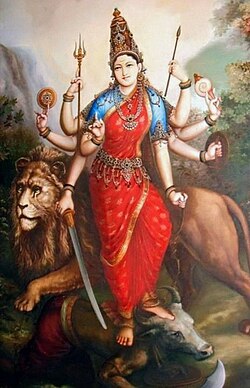
Mahiṣa was a son of Rambhā, an asura, and Mahiṣī, the goddess Gaurī in the form of a female buffalo. Mahiṣa, chief of the asuras became, through austerities, skilled in magical prowess. Invincible, he threatened the gods who were powerless to defeat him. In desperation, they invoked the goddess for assistance. To resounding incantations and mantras, the goddess appeared as a mountain of light, the colour of gold, with the brilliance of a thousand suns. Her eyes were like the nilotpala flower, the blue lily; her hair was black as night; her high, round, prominent breasts proclaimed her feminine divinity. To her, each god contributed his fiery essence and weapons. Śiva, his trident; Viṣṇu, his disk; Varuṇa, his conch; Agni, a dart; Yama, an iron rod; Vayu, a bow; Sūrya, arrows; Kubera, a mace; Indra, a thunderbolt; Brahma, a rosary and waterpot; Kala, a sword; Viśvakarmā, an axe; Himavān, a lion. Thus armed, Durgā went to her home in the Vindhya mountains, where she was worshipped by the tribes of the Śavaras and the Pulindas.1 Mahiṣa, hearing of her intoxicating beauty, sent a message to her, claiming her as his own, for was he not Lord of the three worlds? Durgā smiled and replied that she would only wed the hero who defeated her in battle.
Boastful Mahiṣa accepted the challenge and first sent his asura army to war with her. Kātyāyanī lifted her bow and arrow, and mounted on her Śarabha,2 she defeated the asura hosts. Seeing the slain, she seized a Vīṇā and a Damaru and, laughing in joy, played music. Then Mahiṣa advanced, assuming his form of a deep-black, maddened buffalo, now bellowing, now running, now stamping the ground with his hoofs. A cataclysmic battle commenced. The mountains were rent asunder, the oceans trembled and the clouds scattered in the sky. In vain, the goddess used her god-given weapons, but the buffalo demon escaped her. At last, filled with engulfing anger, she flung aside her weapons, dismounted, and with her bare hands, sprang on the back of Mahiṣa and with her tender, fragrant foot she smote his head. The asura, immune to the weapons of all the gods, fell senseless at the touch of her foot. And she, poised in the serene knowledge of her all-consuming power, took her sword and cut off the head of Mahiṣa. Then, making the gesture that dispels fear with her hand, the goddess appeared smiling. Seeing her victorious, the male gods of the Purāṇas hailed her:
Whatever gentle forms of thine,
And whatever of thy terrible forms wander in the three worlds,
By these forms protect us and the Earth.3
Durgā meditation
Wherever you are, imagine the form of Durgā coalescing out of your surroundings – out of the sky, earth, furnishings, drawing crackling strands of electricity out of nearby power sockets, a corona of energy about her. Visualise the form of Durgā forming above you. Feel her feet upon your head, sending shockwaves of power through your body, and imagine yourself seated on the back of her tiger. Feel the power of Durgā coursing through you and meditate upon her qualities.
The weapons which Durgā bears (given to her by the gods) can be taken, in this meditation, as ‘attachments’ – things which you think you need; tools which you perhaps rely too much on. As Durgā defeated Mahiṣa by herself, so too, your power and poise rests in you, rather than your tools and attachments.
The Navadurgās
The Navadurgās are the Nine Durgās – protective goddesses related to the Eight Directions and the centre. During the Navarātri festival, each of the Nine Durgās are worshipped on successive nights.
- Śailaputrī – the daughter of the Himalaya mountain. Holding a trident and a lotus, she rides a bull. She is identified with Śati.
- Brahmacāriṇī – greatly devoted to Tapas, she holds a rosary and a water pot. She is said to inspire devotion and is identified with Pārvatī.
- Candraghaṇṭā – bearing the crescent moon on her forehead, she is of a golden complexion, has three eyes, ten hands, and makes the gesture of being ready for war. She wears a necklace of bells that terrifies demons. She rides a tiger and protects devotees.
- Kuṣmāṇḍā – She has eight hands bearing weapons, rides a lion, and is said to be particularly pleased by blood sacrifices.
- Skandamātā – the mother of Skanda. She is depicted holding Skanda in her lap. She has three eyes, eight hands, wears a large crown, and has been described as having a face composed of eight types of burnished metal.
- Kātyāyanī – three-eyed and eight-armed, she is said to be the daughter of the sage Kātyāyana.
- Kālarātri – of dark complexion with dishevelled hair, with a fiery breath, riding a donkey. She grants auspicious boons to devotees and enables them to become fearless. She holds a flaming torch and a cleaver.
- Mahāgaurī – depicted as an innocent young girl of eight years, whose ornaments, garments and complexion are all white. She rides a bull.
- Siddhidātrī – granter of the eightfold Siddhis and said to be worshipped by all, even Śiva.
Footnotes
- Vindhyādhivāsinī – the Goddess enshrined in the Vindhyas is one of the epithets of Durgā. This region was considered to be populated by wild, hostile tribes and inaccessible to all but the most heroic.
- A mythical animal, half-elephant and half-tiger.
- Durgā is not only a goddess who responds to threats to the established cosmos, but she responds directly to the petitions of her devotees. Moreover, Durgā, like all deities, acts from the position of Lila or play. She battles the demon because it pleases her to do so. As a battle-goddess, Durgā reverses the Purāṇic stereotype of women as submissive wives or daughters.
